| |
I had a sonogram.
It was a printout from a medical scanner. Its sonar nozzle had slid all
over my wife's distended midriff, greased with clean medical jelly. The
doctor had to wiggle this device about a bit, and peer and head-scratch
through its Delphic, futuristic blurring, but he did it in real time and
right in front of us. The child's limbs were in order, the growth numbers
looked right, and to judge by the sonar shadows of her little pelvis,
she was a girl.
What comfort we took from that technological artifact. With a sonogram
at hand, you can abandon half the book of baby names. You can spin new
plans for the colors of the curtains and the bassinet. This sonogram was
like prenatal radar, full of swimming promise. Primeval darkness had left
the womb. Its silent inhabitant was no longer a "pregnancy." "It" became
"her."
That is how I first glimpsed my daughter: through an instrument. But my
daughter did not, in fact, begin as an infant, or even as a sonogram.
She began, just like her dear mom and dad, just like you, as an anonymous
entity the size of a pencil dot. Humanity's origin is in the realm of
the microscopic. That is the true start of our story.
Human eggs are minuscule, but we moderns can see them. They're no longer
metaphysical, they're not folk legend or fertility ritual. They have become
the province of rapidly advancing biotechnology. Single cells can be measured
and manipulated, extracted and preserved. What we can see, we can sort,
shape, and sell. We penetrated the realm of the microscopic with ever-growing
technical sophistication. In the twentieth century we came to realize,
with growing excitement, that the general business of life on Earth all
runs on the same hardware. It's all cells, and at the centers of cells,
it's always DNA. The business of life is Life-on-Earth Incorporated and
Unlimited, a wholly owned subsidiary of deoxyribonucleic acid.
Genetic engineering is the twenty-first century's own new baby. In the
century's dawn, biotech is its star turn. Biotech is by no means tomorrow's
only major technology. The twenty-first century has the whole technological
family crammed under its roof, fork in hand at the trestle table, a vast
clan of hungry transformations, many of them centuries old: printing,
clocks, railroads, electric power, radio, television, air flight, nuclear
fission, satellites, and computation; it has the works. It's an orgy of
sibling rivalry. But genetic engineering is tomorrow's native-born contribution
to that family. It's the newest, the riskiest, and if it survives and
flourishes, it will become the most powerful. Biotech is a baby Hercules
that wants to kick the slats out of the crib.
Babies don't stay babies. My first daughter, for instance, is for the
moment a thriving teen. Her rocketing passage toward maturity is written
all over her; every day sees her blatantly learning and growing. Biotech
is the baby industry now, but when it's big, it will reshape reality.
To describe a biotech world, a world with a mature genetic technology,
requires a new language. A new vocabulary, a new set of assumptions, a
new literacy.
A baby, once she gets going, does not stop. It's a very different world,
the future, but we're never going to "get there." There's no place "there"
for us to get. The future is a process, not a theme park. The future itself
has a future. We, in this present moment, are part of the future's past.
The future is not an alien world, it is this very world, with different
people, at a different time. Yesterday, today, or tomorrow, the clock
never stops ticking. Every new stage must grow on the mulch of the last.
Bearing that in mind, let me introduce you into a biotech world. Here
you are, let us say, reading a book. Not this book (unless you're some
kind of antiquarian) but a similar one. Are there books in your biotech
world? Yes. Made of paper? Sort of. Is that ink? Not ink as ink was previously
understood, no; but why would you bother to notice that?
Let me make a few impolite personal observations as you sit there reading.
By twentieth-century standards, you don't look very clean. In fact, you
look rather greasy, and you're somewhat odd-smelling. But you are impressively
robust and glittery-eyed, and full of animal vitality. Even though you
are a harmless reader of late-twenty-first-century pop-science books,
praiseworthily engaged in the intellectual trends of your own decade,
you don't look especially scholarly. On the contrary: basically, you look
like an athlete or supermodel. You look that way not because you're all
egotistically eager to stand out from the norm but because that is your
norm. An athlete or a supermodel is what men and women are willing to
pay to look like. In your epoch, flesh and the processes of its construction
are very ductile. You have no tooth decay, no dandruff, no enlarged pores.
Though you read too much, you have no glasses.
Your home is snug and elegant. Its walls, floors, and furnishings are
made of warm, organic substances that resemble cork, bamboo, and redwood,
although they aren't. The lawn outside your membrane window has eight
or nine hundred species living in it. It is a biodiverse menagerie.
You're just a normal person in a biotech world. You are not some grand
chrome-dome master of biotech--no single mind can ever master such a broad
field. Biotech is not even your personal line of work; you just live there.
Your lawn is aswarm with living things because of social pressure from
your neighbors. A mowed lawn is a scandal; you wouldn't subject the neighborhood
to such a sight any more than you'd shave your children's heads to eradicate
lice. You don't go out there and garden it, either. The lawn tools know
more about plants than you do. And they work by themselves. It's a city
lawn, not a wilderness. It's autogardening. The "wild" animals living
in it don't know they are under surveillance.
Out on the street are scarab-colored nonpolluting vehicles that run on
hydrogen. Like most industrial objects, they rot on command and return
to harmless compost. Then there's your plumbing, or, as people put it
nowadays, your "waterworks." In a biotech world, water networks are a
bigger deal than bit streams. You're not made out of digital bits--like
all living things, you are made mostly of water. So that's where you sensibly
place your high-tech investments.
You don't have a "shower stall." You have a standard, everyday body-imaging
system that gives you complete interior and exterior health scans every
morning as it washes you. Your toothbrush scans the contents of your mouth
and catalogs its microorganisms. Your toilet is the most sophisticated
network peripheral in the home. It provides you with vital metabolic information
about your body--the substances that enter and leave it and the vital
processes within it. Only fools are squeamish about this.
Your bathroom cabinet is full of unguents, greases, and perfumes. There
are some pills in there, but most of them do not contain drugs. Instead,
they contain living, domesticated organisms that make drugs while living
inside you. Some of the "pills" are cameras, with tiny sensors and onboard
processing. Nothing in your medicine cabinet is sterile, not even the
bandages. Modern bandages contain living organisms that are good for wounds.
"Sterility" is what people do need when they don't know what's happening
on a microbial level. In a biotech world, sterility is a confession of
ignorance. It's a tactic of desperation.
In your kitchen, the mops have more processing power than twentieth-century
national bureaucracies. Your kitchen is mostly a place of filters and
membranes and films; it is certainly not a butcher shop or a place to
process raw vegetable matter. You eat delicate and tasty knickknacks that
differ radically from grotesque historical foodstuffs. You have no fridge,
because nothing in your house ever rots without your permission.
Even though this is a genetically altered world, there are no weird-looking
"mutants" or "monsters" in your house, neighborhood, or city. You don't
have, for instance, a six-legged dog. The cop on the beat is not ten feet
high, and she does not look like RoboCop; if she has a baton, it doubles
as a swab. It's not that such things are impossible for you and yours.
Of course they are possible, but they are also crude publicity stunts
dating from the eye-goggling infancy of biotech. In a mature biotech world,
such nine-day wonders are considered crass and corny. They make no common
sense.
Back in the early days of harnessing DNA, people were always fussing about
full-grown multicellular beings--genetically altered humans, plants, or
animals. There was a lot of anxious talk about clones (genetic duplicates)
or chimeras (creatures with fused cells, whose bodies are mosaics of different
species). Genetically modified organisms contained snippets of alien DNA,
such as the artist Eduardo Kac's rabbit "Alba." That arty little rabbit,
infused with jellyfish genes, could glow bright green in public. Alba
the rabbit made a well-nigh perfect art-world cause c�l�bre at the dawn
of the twenty-first century. Alba really panicked the bourgeoisie and
was a nice succ�s de scandale, a worthy credit to the social insight of
the artist. But once you'd manufactured a glowing green rabbit and shown
it off, why would you ever want or need more than one?
For you, a modern DNA-literate person, weird animals have very little
to do with the actual, real-world genetic industry. Frankly, the flesh
of full-grown plants and animals just gets in the way. They might be dramatic
examples of the concept (the way humanoid robots were once dramatic versions
of the concept of automation). But the "threat" of "automation" turned
out to be mostly hokum, and there were never any humanoid robots clanking
around in real life, working on assembly lines. The same objection goes
for monster Frankenstein animals. Yes, they sound really cool and scary,
but go ahead, make one. Where is the market?
Expressing DNA in the genomes of large organisms is slow and clumsy. Creating
an animal means deputizing some large and reluctant multicellular bureaucracy
to carry out your will. That is not where the action is. It doesn't take
efficient, industrial advantage of the raw power of DNA as a means of
production.
Livestock requires long, solemn months of growth and delivery, just like
a human baby. That is not industry, that is traditional unskilled labor.
All the real DNA action is in single cells. A genuine genetic engineer
cuts to the chase and ratchets right down to the molecular hardware of
the famous double helix. This news is no great surprise to you, for you
were taught all this in grade school. You were shown the proper instruments
for the job. You got down to the microbial level where DNA does all its
heavy lifting, and you stayed down there. You marinated yourself in that
seething point of view. You got all cozy with it. You got used to it.
And if you happen to work there--and most people of your epoch have at
least some kind of brush with DNA, the way most people used to have a
nodding acquaintance with computers, or cars--then you study it and record
it, analyze it, sequence it, copy it, map it, tag it, recombine it, commercialize
it, exploit it, buy and sell it every day. It's how you modern folk live.
You know that DNA is not just a big molecule. DNA is history. Like a baby
book, DNA is a personal archive, full of profound revelations about your
identity. You shed clouds of your personal DNA wherever you go, the material
evidence of your life and your flesh. DNA carried ethnicity out of the
old-fashioned world of folktales and flag-waving and into your world of
factual, measurable relationships between chains of human code. So DNA
isn't "a molecule"--DNA is us.
Your ancestors knew just two kingdoms of earthly life: plants and animals.
You know more than seventy. Most of those kingdoms--vast realms of metabolic
activity--belong exclusively to the single-celled. That's where the variety
is, where DNA's skill set has been best developed. Microorganisms were
busily manipulating DNA for three billion years before anything multicellular
showed up on the scene. Most life is, and always has been, microbial.
The variety of microbes is colossal, much wider than that of all multicellular
animals. There are microorganisms living in boiling water and eating cyanide
and sulfur. They're as different from humans, and from one another, as
tigers are from cabbages.
As a DNA-literate person at ease with these facts of real life, you know
that genetics is not a realm of boffin technicians in white lab coats.
White lab coats are absurd to you, hopelessly old-fashioned. Lab coats
were designed to show spills, so that they could remain sterile. For you
that garb is like the armor of a medieval knight. If you spill anything
remotely dangerous or bioactive on yourself, the doorway will tell you;
the bathroom will tell you; a taxi, an air conditioner, a stove can tell
you. A five-year-old child can tell you not just that you have an influenza
virus but what kind you have and where it came from.
You're into germs. Oh sure, you've got a cat; people who read books like
cats. Sometimes they even like cat books. But you'd never expect your
cat to do any industrial heavy lifting. Besides, your cat doesn't live
inside of you. In a biologically savvy world, inside of you is where it's
at.
You're into germs because germs are into you. No man ever walks alone.
Every human adult carries about two pounds of living bacteria, or about
a hundred trillion nonhuman cells. This is entirely normal and good. It's
something you understand about the real world that twentieth-century people
did not see and could not perceive. They had this crude, desperate insight
they called "sanitation," while you possess a genuine insight and a hands-on
technical mastery of that situation. Unlike those blind primitives, you
walk your seething Earth in an aware, fully engaged, progressive, civilized
fashion. You swarm inside and out with microbes, and it's good for you.
You recognize and celebrate this. People chat about their germs over coffee--it's
like comparing perfumes. In your world, germs are the perfumes. Anyone
who smells bad is an utter ignoramus.
Your mother gave you her mitochondria when she gave you life. Mitochondria
are formerly free-living organisms that have been perking along in the
cells of human flesh for several billion years. They seem genetically
foreign, yet they are also a vital part of humanity. Without mitochondria,
we have no energy. It follows that to be truly antiseptic is instantly
fatal. To lose your mitochondria "infection" would mean to die horribly,
reduced to a flaccid bag of jelly. For you, losing your favorite microbes
in and on your skin, bowels, and organs would be a grave environmental
setback, like losing topsoil and songbirds. As for your handy mitochondria,
you're very interested in souping them up. They are your beloved little
engines--and you want some heavy-duty ones.
Excerpted from Tomorrow Now by Bruce Sterling Copyright�
2002 by Bruce Sterling. Excerpted by permission of Random House, a division
of Random House, Inc. All rights reserved. No part of this excerpt may
be reproduced or reprinted without permission in writing from the publisher.
|
|
(back
to top)
Synopsis
“Nobody
knows better than Bruce Sterling how thin the membrane between science
fiction and real life has become, a state he correctly depicts as both
thrilling and terrifying in this frisky, literate, clear-eyed sketch of
the next half-century. Like all of the most interesting futurists, Sterling
isn’t just talking about machines and biochemistry: what he really
cares about are the interstices of technology with culture and human history.”
-Kurt Andersen, author of Turn of the Century
Visionary
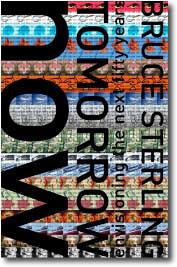
author Bruce Sterling views the future like no other writer. In his first
nonfiction book since his classic The Hacker Crackdown, Sterling
describes the world our children might be living in over the next fifty
years and what to expect next in culture, geopolitics, and business.
Time
calls Bruce Sterling “one of America’s best-known science fiction
writers and perhaps the sharpest observer of our media-choked culture
working today in any genre.” Tomorrow Now is, as Sterling
wryly describes it, “an ambitious, sprawling effort in thundering
futurist punditry, in the pulsing vein of the futurists I’ve read
and admired over the years: H. G. Wells, Arthur C. Clarke, and Alvin Toffler;
Lewis Mumford, Reyner Banham, Peter Drucker, and Michael Dertouzos. This
book asks the future two questions: What does it mean? and How does it
feel? ”
Taking a
cue from one of William Shakespeare’s greatest soliloquies, Sterling
devotes one chapter to each of the seven stages of humanity: birth, school,
love, war, politics, business, and old age. As our children progress through
Sterling’s Shakespearean life cycle, they will encounter new products;
new weapons; new crimes; new moral conundrums, such as cloning and genetic
alteration; and new political movements, which will augur the way wars
of the future will be fought.
Here are
some of the author’s predictions:
- Human
clone babies will grow into the bitterest and surliest adolescents ever.
- Microbes
will be more important than the family farm.
- Consumer
items will look more and more like cuddly, squeezable pets.
- Tomorrow’s
kids will learn more from randomly clicking the Internet than they ever
will from their textbooks.
- Enemy
governments will be nice to you and will badly want your tourist money,
but global outlaws will scheme to kill you, loudly and publicly, on
their Jihad TVs.
- The future
of politics is blandness punctuated with insanity.
- The future
of activism belongs to a sophisticated, urbane global network that can
make money—the Disney World version of Al Qaeda.
Tomorrow
Now will change the way you think about the future and our place in
it
(back
to top)
Author
 Bruce
Sterling is the author of nine novels, three of which were selected
as New York Times Notable Books of the Year. The Difference Engine, co-written
with William Gibson, was a national bestseller. He has also published
three short-story collections and one nonfiction book, The Hacker Crackdown.
He edited the anthology Mirrorshades and has written for many magazines,
including Newsweek, Fortune, Harper’s, Details, Whole Earth Review,
and Wired, where he has been a contributing writer since its conception.
In 1999, he won the Hugo Award in the short-story category. He lives in
Austin, Texas. Bruce
Sterling is the author of nine novels, three of which were selected
as New York Times Notable Books of the Year. The Difference Engine, co-written
with William Gibson, was a national bestseller. He has also published
three short-story collections and one nonfiction book, The Hacker Crackdown.
He edited the anthology Mirrorshades and has written for many magazines,
including Newsweek, Fortune, Harper’s, Details, Whole Earth Review,
and Wired, where he has been a contributing writer since its conception.
In 1999, he won the Hugo Award in the short-story category. He lives in
Austin, Texas.
|